Narayana Murthy Urges Youth to Prepare for AI Disruption
Infosys co-founder Narayana Murthy has urged young Indians to prepare for rapid AI-driven workplace changes. He emphasized continuous learning, critical thinking, and adaptability as essential skills for future success. As automation reshapes industries, professionals must move beyond routine tasks and focus on innovation, leadership, and strategic value creation.
Artificial intelligence is no longer an emerging trend—it is a defining force shaping the global economy. Across industries, from banking and healthcare to manufacturing and information technology, AI-powered systems are transforming how businesses operate. As this technological wave accelerates, Infosys co-founder Narayana Murthy has called on India’s young workforce to prepare for a future where adaptability and intellectual depth will determine professional success.
In a recent interaction with business media, Murthy emphasised that the rise of AI is not a distant possibility but an ongoing shiftalready influencing hiring decisions, skill requirements, and productivity expectations. His message to students and early-career professionals was straightforward: continuous learning is no longer optional—it is essential.
AI Is Redefining the Nature of Work
Artificial intelligence systems have rapidly evolved from simple automation tools into complex problem-solving platforms. They can now analyze large datasets, generate detailed reports, assist in software development, and even simulate human conversation with impressive accuracy.
According to Murthy, this progress means that many routine and structured tasks—particularly those involving repetitive data handling—are increasingly susceptible to automation. Entry-level roles that once involved processing information or performing standardized procedures may gradually decline as organizations adopt AI-driven solutions.
However, he clarified that AI will not eliminate jobs overnight. Instead, the transformation will occur gradually, reshaping job descriptions and shifting the focus toward higher-value contributions. The challenge for young professionals lies in recognizing this shift early and adjusting accordingly.
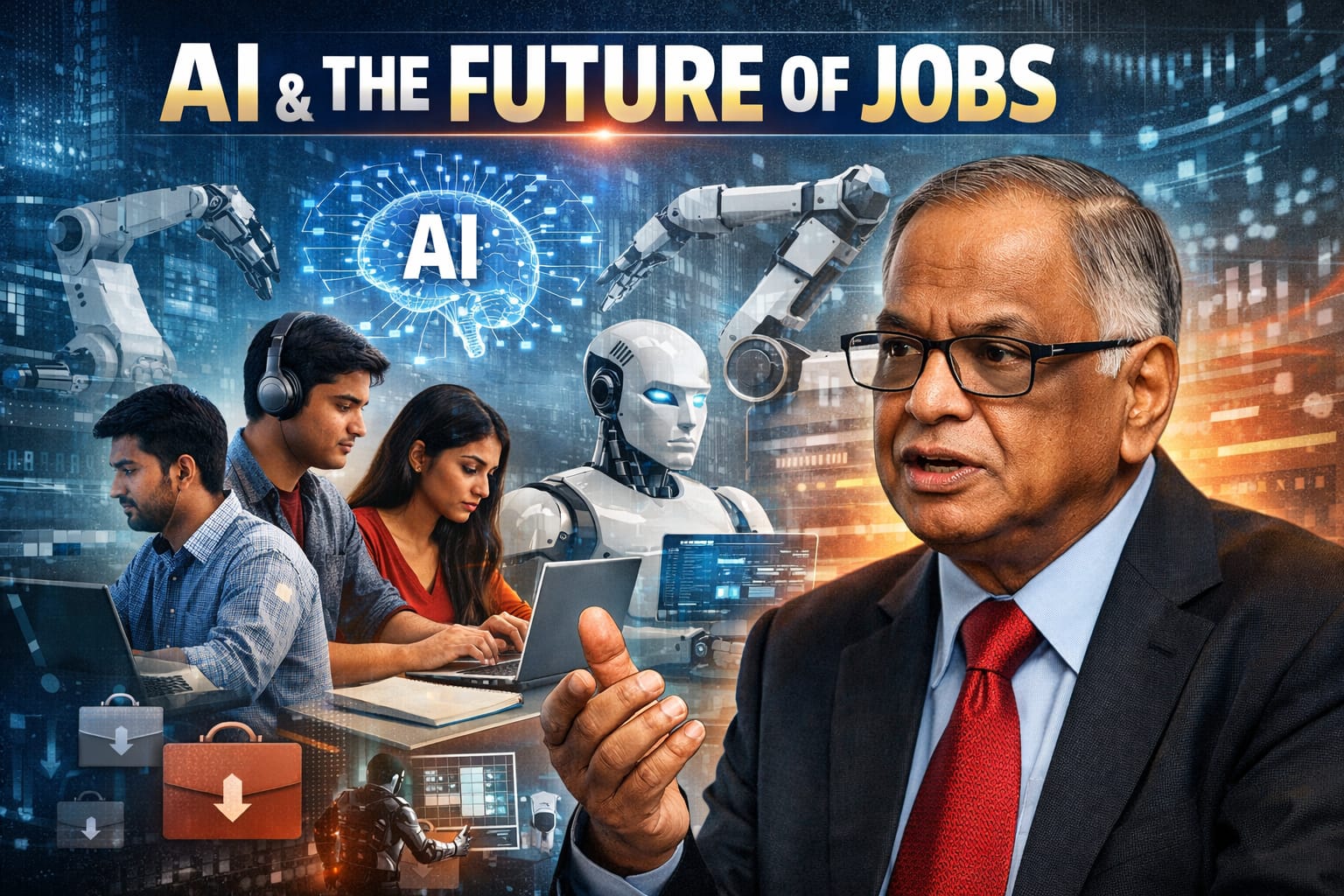
Image Caption: Narayana Murthy urges young professionals to adapt to artificial intelligence-driven workplace changes. Image Credit: Artificial Intelligence concept image / Generated via AI
Narayana Murthy urges young professionals to adapt to artificial intelligence-driven workplace changes.
Image Credit: Artificial Intelligence concept image / Generated via AI
Why Young Indians Must Pay Attention Now
With a significant portion of its population under the age of 35, India represents one of the youngest workforces globally. Each year, millions of graduates step into competitive job markets with aspirations of stability and growth. Traditionally, academic qualifications combined with basic technical skills have been enough to open professional doors.
Murthy cautions that this formula is rapidly evolving. In an AI-driven environment, employers are increasingly valuing analytical ability, creativity, and adaptability over routine technical proficiency alone.
Young professionals must therefore go beyond textbook knowledge. They need to cultivate skills that allow them to interpret AI outputs, question automated decisions, and contribute meaningfully to complex projects. The future will favor individuals who can work alongside intelligent systems rather than perform tasks those systems can execute more efficiently.
Moving Beyond Routine Work Toward Strategic Impact
One of the most profound effects of AI is the transformation of how value is created inside organizations. For decades, many roles focused heavily on executing predefined tasks within fixed frameworks. Today, AI tools can handle a growing share of those responsibilities with speed and precision.
This evolution does not eliminate the importance of human talent—it elevates it.
Professionals are now expected to provide insights, design strategies, and make nuanced decisions that require contextual awareness. The emphasis is shifting from simply completing assignments to shaping outcomes.
Murthy argues that productivity in the AI era should be measured not by the number of hours spent working but by the depth of thinking applied to challenges. Individuals who can interpret complex data, anticipate risks, and innovate solutions will stand out in an increasingly automated environment.
AI’s Expanding Influence Across Industries
Artificial intelligence is reshaping operations across diverse sectors:
Finance: Algorithms analyze transactions, assess risk profiles, and detect suspicious activities in real time.
Healthcare: Machine learning tools assist doctors in interpreting scans and predicting disease progression.
Manufacturing: Smart systems monitor supply chains, reduce waste, and optimize production cycles.
IT Services: AI-driven coding assistants speed up development and testing processes.
Customer Experience: Automated chat systems manage large volumes of customer interactions efficiently.
This widespread adoption demonstrates that AI is not confined to technology companies alone. It is becoming an integral component of modern business strategy.
Image Caption: Narayana Murthy urges young professionals to adapt to artificial intelligence-driven workplace changes. Image Credit: Generated with AI / Representative Image
Narayana Murthy urges young professionals to adapt to artificial intelligence-driven workplace changes.
Image Credit: Generated with AI / Representative Image
Machines can process vast amounts of information, but they lack true comprehension. Humans must evaluate outputs, identify biases, and determine practical implications.
Creativity
Innovation often emerges from imagination and emotional intelligence—qualities that algorithms cannot genuinely replicate.
Ethical Decision-Making
AI systems operate based on programmed logic, but ethical judgment requires empathy and social awareness.
Leadership and Communication
Building trust, motivating teams, and navigating interpersonal dynamics are human strengths that technology cannot replace.
Murthy suggests that professionals who combine technological literacy with these human capabilities will enjoy long-term relevance.
Lifelong Learning as a Professional Imperative
A key theme in Murthy’s perspective is the importance of continuous upskilling. The pace of technological change means that expertise can quickly become outdated. Professionals must proactively update their knowledge through certifications, workshops, and hands-on experimentation with emerging tools.
Learning should also extend beyond one’s core discipline. Exposure to economics, behavioral science, communication, and global trends can provide broader insights that enhance decision-making.
Curiosity and adaptability are becoming career-defining traits. Those who embrace change will be better equipped to navigate uncertainty.
Humans and AI: A Collaborative Future
Rather than perceiving AI as a threat, Murthy encourages viewing it as a powerful collaborator. Intelligent systems can handle repetitive analysis and generate preliminary outputs, allowing professionals to focus on higher-level responsibilities.
For instance, a marketing strategist might use AI to analyze consumer behavior patterns, then apply human insight to craft compelling campaigns. A software architect may rely on AI-generated code suggestions while concentrating on system design and innovation.
When used effectively, AI amplifies human potential instead of diminishing it.
Murthy’s message carries implications beyond individual careers. Educational institutions may need to redesign curricula to emphasize problem-solving, interdisciplinary thinking, and digital literacy.
Corporations should prioritize structured reskilling initiatives to prepare employees for evolving demands. Policymakers, meanwhile, must ensure that technological growth leads to inclusive economic progress rather than widening disparities.
Aligning education, industry needs, and policy frameworks will be crucial in ensuring that India benefits fully from the AI revolution.
A Balanced Outlook on Technological Change
Although AI’s capabilities are expanding rapidly, Murthy does not predict widespread joblessness. Historically, technological revolutions have disrupted certain roles while creating new industries and employment categories.
The difference today lies in speed. The AI transformation is unfolding faster than previous industrial shifts, requiring quicker adaptation from both institutions and individuals.
Preparation—not fear—is the appropriate response.
Conclusion: Adapting to Thrive
Artificial intelligence will continue to redefine professional landscapes. For young Indians entering the workforce, the path to success lies in intellectual flexibility, creativity, and continuous growth.
Murthy’s core message is clear: the future will belong to those who invest in sharpening their minds and expanding their capabilities. As machines grow smarter, human intelligence must evolve alongside them.
In the age of AI, relevance will not be determined by routine skills alone, but by the ability to think critically, innovate boldly, and lead responsibly.