
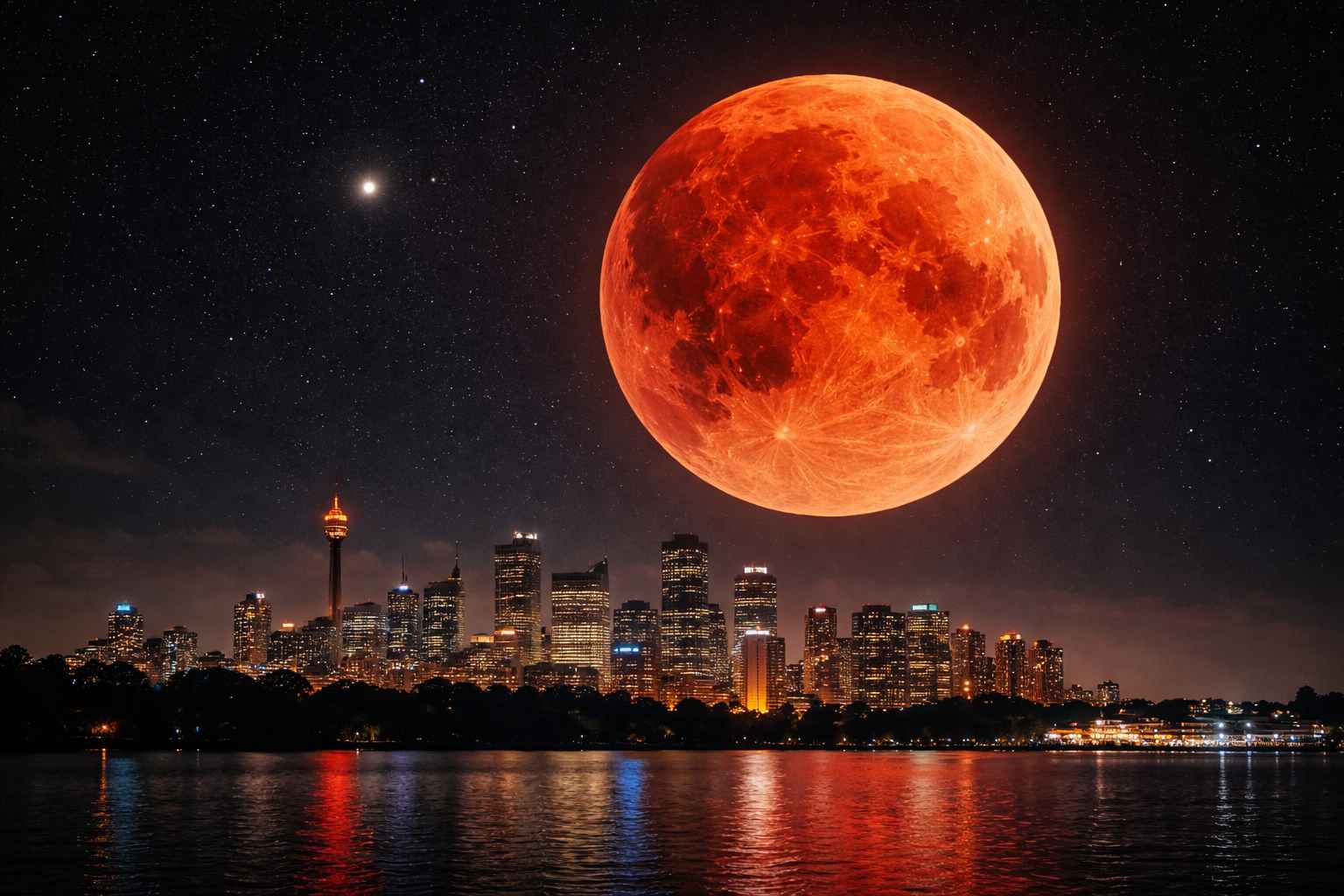
Rare ‘Blood Moon’ Total Lunar Eclipse to Paint the Sky in Fiery Red on March 3
Skywatchers across North America, Australia, and New Zealand are preparing for one of the most striking celestial events of the decade—a rare total lunar eclipse, widely known as a “blood moon,” set to illuminate the night on 3 March. The event promises a dramatic transformation of the full moon into a deep, coppery red orb, creating a spectacle that won’t return in the same form for nearly three years.
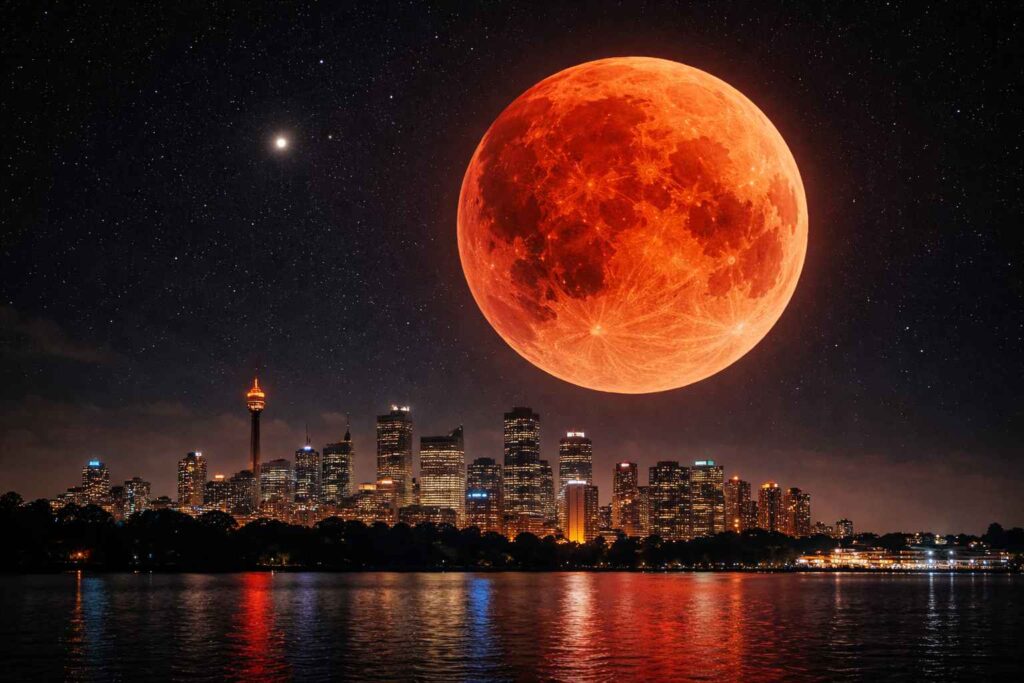
Image Credit: AI Generated Image (DALL·E) | S24 Bulletin
What Makes a “Blood Moon” So Special?
A total lunar eclipse occurs when the Earth moves precisely between the Sun and the Moon, blocking direct sunlight from reaching the lunar surface. Instead of going completely dark, however, the Moon glows red.
This crimson glow happens because Earth’s atmosphere bends and filters sunlight. Shorter blue wavelengths scatter away, while longer red and orange wavelengths pass through and reach the Moon. The effect is similar to the colors seen during sunrise or sunset—but projected onto the lunar surface.
The deeper the Moon travels into Earth’s shadow (known as the umbra), the richer and darker the red shade appears. Atmospheric conditions—such as dust, pollution, or volcanic particles—can intensify the color.
Where and When to Watch
The eclipse will be visible in different phases depending on geographic location, with optimal viewing times varying across regions.
Australia Viewing Times
Australians will enjoy the eclipse during comfortable evening hours:
- Sydney, Canberra, Melbourne, Hobart: 10:04pm – 11:02pm
- Brisbane: 9:04pm – 10:02pm
- Adelaide: 9:34pm – 10:32pm
- Darwin: 8:34pm – 9:32pm
- Perth: 7:04pm – 8:02pm
For best visibility, head to a dark location away from city lights and give your eyes about 15 minutes to adjust to the darkness.
New Zealand Viewing Times
In New Zealand, the eclipse will reach its deepest phase shortly after midnight. The Moon will be high in the sky, offering excellent viewing conditions across the entire country. Anyone who can see the Moon will be able to witness the eclipse.
North America Viewing Times
In North America, the eclipse will unfold in the early hours of March 3:
- New York, Washington DC: 3:44am – around 6:30am
- Detroit: 3:44am – 7:06am
- New Orleans, Chicago: 2:44am – around 6:24am
- San Francisco, Los Angeles: 12:44am – around 6:23am
Observers near the edge of the visibility zone may see only part of the eclipse if the Moon sets before the event concludes.
Other Major Cities Joining the Show
Several international cities will also experience the spectacle:
- Tokyo: 5:44pm – 11:23pm
- Beijing: 6:00pm – 10:23pm
- Manila: 5:57pm – 10:23pm
- Jakarta: 6:06pm – 9:23pm
A Celestial Bonus: Jupiter Joins the Scene
Adding to the drama, the planet Jupiter will shine brightly in the night sky during the eclipse. The pairing of the red Moon and luminous Jupiter will create a visually stunning astronomical moment, perfect for photography enthusiasts.
No special equipment is needed to observe a lunar eclipse—unlike a solar eclipse, it is completely safe to watch with the naked eye. However, binoculars or a telescope can enhance the details of the Moon’s surface during totality.
When Is the Next Total Lunar Eclipse?
Total lunar eclipses occur roughly every 18 months to three years. After March 3, the next total lunar eclipse will take place on New Year’s Eve 2028. That event will be visible across Europe, Asia, Australia, and Africa—but not the Americas.
North America will have to wait until June 2029 for its next total lunar eclipse view.
Before that, a partial lunar eclipse is scheduled for 28 August 2026, with the Americas and Africa enjoying the clearest view.
The Meaning Behind the Blood Moon
Scientifically, a blood moon is simply an astronomical alignment. But historically, it has inspired awe, fear, and myth across cultures.
Ancient civilizations often interpreted the red Moon as a sign of danger or transformation. Some believed it symbolized celestial battles, divine anger, or cosmic warnings. In modern times, such interpretations have faded, replaced by scientific understanding and global enthusiasm for sky events.
Still, the emotional impact remains powerful. Watching the Moon slowly darken and then glow red is a humbling reminder of Earth’s movement through space—a silent dance between Sun, Earth, and Moon.
Why You Shouldn’t Miss It
This total lunar eclipse is more than just a scientific occurrence—it’s a shared global experience. In a fast-paced digital world, it offers a rare opportunity to pause, look up, and witness the mechanics of our solar system in action.
Whether you’re in the quiet suburbs of Australia, the city lights of North America, or under the midnight sky in New Zealand, March 3 will deliver a breathtaking cosmic performance.
Mark your calendar, set your alarm if needed, and step outside. The sky is about to turn red.









Lunar eclipse is an astronomical event