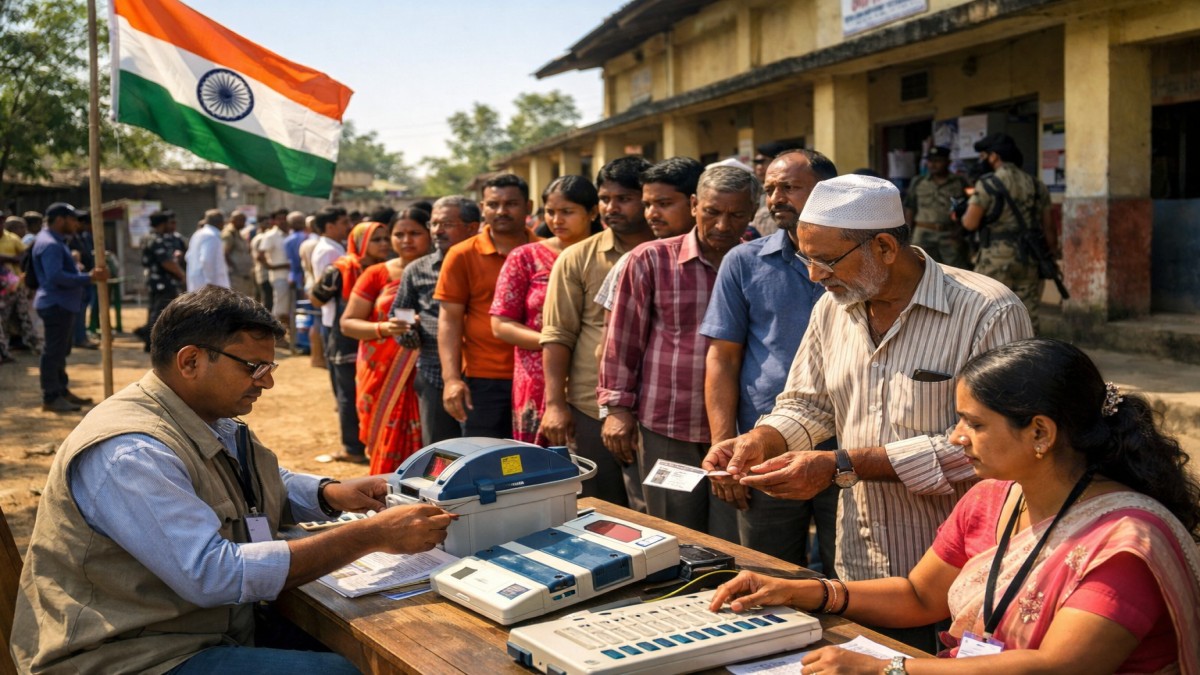
Assembly Elections 2026: West Bengal to Vote in Two Phases, Assam, Kerala, Tamil Nadu and Puducherry Poll on April 9
Assembly Elections 2026 – Key Highlights
- States Voting: West Bengal, Assam, Kerala, Tamil Nadu
- Union Territory: Puducherry
- Total Voters: Around 17.4 Crore
- Polling Stations: 2.19 Lakh
- Election Staff: 25 Lakh Officials
- Vote Counting Date: May 4, 2026
- Security Measure: 100% Webcasting at Polling Booths
India is preparing for another major electoral battle as the Election Commission of India has officially announced the schedule for the 2026 Assembly elections in five states and one Union Territory. The states going to polls include West Bengal, Assam, Kerala, Tamil Nadu and the Union Territory of Puducherry. According to the announcement made by Chief Election Commissioner Gyanesh Kumar during a press conference in New Delhi on March 15, the elections will take place in April while the counting of votes will be held on May 4, 2026.
The upcoming elections are expected to be one of the largest democratic exercises in the world this year, with approximately 17.4 crore voters eligible to cast their votes across more than two lakh polling stations. The Election Commission has also introduced several new initiatives aimed at increasing transparency and improving the voting experience for citizens.
West Bengal Election to be Held in Two Phases
West Bengal Assembly Election 2026
The West Bengal Assembly election will be conducted in two phases, significantly fewer than the eight phases held during the 2021 election. The move is expected to reduce election expenses and simplify security deployment.
- Phase 1 Voting: April 23, 2026
- Phase 2 Voting: April 29, 2026
- Nomination Deadline: April 6 and April 9
- Scrutiny of Nominations: April 7 and April 10
- Vote Counting: May 4, 2026
Chief Minister Mamata Banerjee is aiming for a fourth consecutive term as political parties prepare for an intense campaign.
Among all the poll-bound states, West Bengal will witness the most closely watched contest. The state will go to the polls in two phases on April 23 and April 29. The decision to hold elections in two phases marks a significant change compared to the 2021 Assembly elections, which were conducted in eight phases amid the COVID-19 pandemic.
Election officials explained that reducing the number of phases would help make the process more convenient for voters, candidates and election officials while also reducing campaign expenses. The move is also expected to speed up the deployment of security forces and streamline election management across the state.
West Bengal politics is expected to witness intense competition as Chief Minister Mamata Banerjee seeks a fourth consecutive term in power. Her party, the Trinamool Congress, achieved a decisive victory in the 2021 Assembly elections by winning 215 seats in the 294-member Assembly.
The Bharatiya Janata Party emerged as the main opposition in that election by winning 77 seats. For the 2026 polls, the BJP is expected to run an aggressive campaign focused on issues such as corruption allegations, governance concerns and law and order.
Key Political Issues in West Bengal
The 2026 West Bengal election campaign is likely to revolve around several major issues that have dominated political discussions in the state over the past few years. One of the most controversial topics is the Special Intensive Revision (SIR) of voter lists conducted by the Election Commission.
During the revision process, approximately 63 lakh names were reportedly removed from the voter list. Opposition parties, particularly the Trinamool Congress, have criticized the exercise and accused the Election Commission of removing legitimate voters. However, the Election Commission has maintained that the process is a routine exercise designed to remove duplicate or ineligible names from electoral rolls.
Another important issue is corruption allegations against the state government, including controversies related to recruitment in government jobs. The Supreme Court’s decision to cancel thousands of teacher recruitment appointments has also become a major political talking point.
Law and order concerns and women’s safety are expected to feature prominently in campaign speeches as opposition parties attempt to highlight incidents that sparked public debate in recent years.
Polling Schedule for Other States
| State / UT | Polling Date | Phases | Counting Date |
|---|---|---|---|
| West Bengal | April 23 & April 29 | 2 Phases | May 4 |
| Tamil Nadu | April 23 | Single Phase | May 4 |
| Kerala | April 9 | Single Phase | May 4 |
| Assam | April 9 | Single Phase | May 4 |
| Puducherry | April 9 | Single Phase | May 4 |
While West Bengal will vote in two phases, the remaining states and the Union Territory of Puducherry will hold elections in a single phase. Assam, Kerala and Puducherry will all vote on April 9, 2026.
Tamil Nadu will go to polls on April 23, the same day as the first phase of voting in West Bengal. All votes from these elections will be counted together on May 4.
The Election Commission noted that holding most elections in a single phase helps simplify logistics and reduces the burden on security forces.
Massive Electoral Exercise Across India
New Election Reforms Introduced by the Election Commission
The Election Commission of India has introduced more than 30 new initiatives over the past year to improve transparency and enhance voter experience during the 2026 Assembly elections.
- 100% webcasting at all polling stations
- Coloured photographs of candidates on EVMs
- Mobile phones deposited outside polling booths
- Maximum 1,200 voters per polling station
- ECINET mobile application for voter services
- Real-time voting percentage updates every two hours
These measures aim to ensure free, fair and transparent elections across all poll-bound states.
The Election Commission has stated that around 17.4 crore voters will participate in the elections across the five regions. To accommodate this large electorate, voting will be conducted at approximately 2.19 lakh polling stations.
More than 25 lakh election officials will be deployed to manage the voting process, ensure security and supervise counting procedures.
International observers are also expected to witness the elections. According to the Election Commission, delegates from election authorities of around 20 countries may visit India to observe the democratic process.
New Initiatives Introduced by the Election Commission
Assembly Elections 2026 – Overview
The Election Commission of India has announced the schedule for the 2026 Assembly elections in West Bengal, Assam, Kerala, Tamil Nadu and the Union Territory of Puducherry. Around 17.4 crore voters are expected to participate across 2.19 lakh polling stations.
- Voting Dates: April 9, April 23 and April 29
- Counting of Votes: May 4, 2026
- Total Election Officials: 25 lakh+
- Polling Stations: 2.19 lakh across five regions
- Security Measure: 100% webcasting at polling booths
The Election Commission has introduced more than 30 new measures over the past year to improve election transparency and voter experience.
One major initiative is the implementation of 100 percent webcasting at all polling stations. This step aims to increase transparency and allow authorities to monitor voting activities in real time.
Presiding officers will also report voter turnout figures every two hours, allowing media outlets and the public to receive more accurate updates throughout polling day.
Another important reform is the introduction of coloured photographs of candidates on Electronic Voting Machines (EVMs). This feature is expected to reduce confusion among voters and help them easily identify candidates.
In addition, mobile phones will not be allowed inside polling booths and voters will be required to deposit them outside before entering.
ECINET Mobile App to Support Voters
To improve accessibility and convenience, the Election Commission has launched the ECINET mobile application. The app integrates multiple election-related services into a single platform.
Through ECINET, voters can access information about polling stations, candidate lists, voter rolls and election updates. The app is designed to make it easier for citizens to stay informed and participate in the electoral process.
Election officials believe the digital platform will significantly enhance voter engagement and provide real-time information during the election period.
Model Code of Conduct Comes Into Effect
With the announcement of the election schedule, the Model Code of Conduct has come into force across the poll-bound states and Puducherry.
The code restricts governments from announcing new schemes or policies that could influence voters. Chief Election Commissioner Gyanesh Kumar emphasized that while governments can make policy decisions, any action that may affect election outcomes will not be allowed after the Model Code takes effect.
The Election Commission also addressed concerns related to misinformation and deepfake content during elections. State-level monitoring teams will track online content and take action against fake or misleading information by filing FIRs and removing such material from digital platforms.
Opposition Demands Removal of Chief Election Commissioner
In a separate political development, members of the INDIA opposition bloc recently submitted a notice in Parliament seeking the removal of Chief Election Commissioner Gyanesh Kumar.
The notice reportedly carries signatures from 193 Members of Parliament, including more than 130 from the Lok Sabha and over 60 from the Rajya Sabha.
This marks the first time such a notice has formally crossed the required threshold in Parliament. However, election authorities have declined to comment on ongoing legal or political disputes.
Democratic Process Under Global Spotlight
With millions of voters, hundreds of thousands of polling stations and extensive logistical planning, the 2026 Assembly elections represent another massive democratic exercise in India.
The Election Commission has emphasized that its goal is to ensure free, fair and transparent elections through technological improvements, enhanced monitoring and voter-friendly initiatives.
As campaigning intensifies over the coming weeks, political parties will attempt to win the support of millions of voters across diverse regions. The results declared on May 4 will determine the next governments in five politically significant regions of the country.