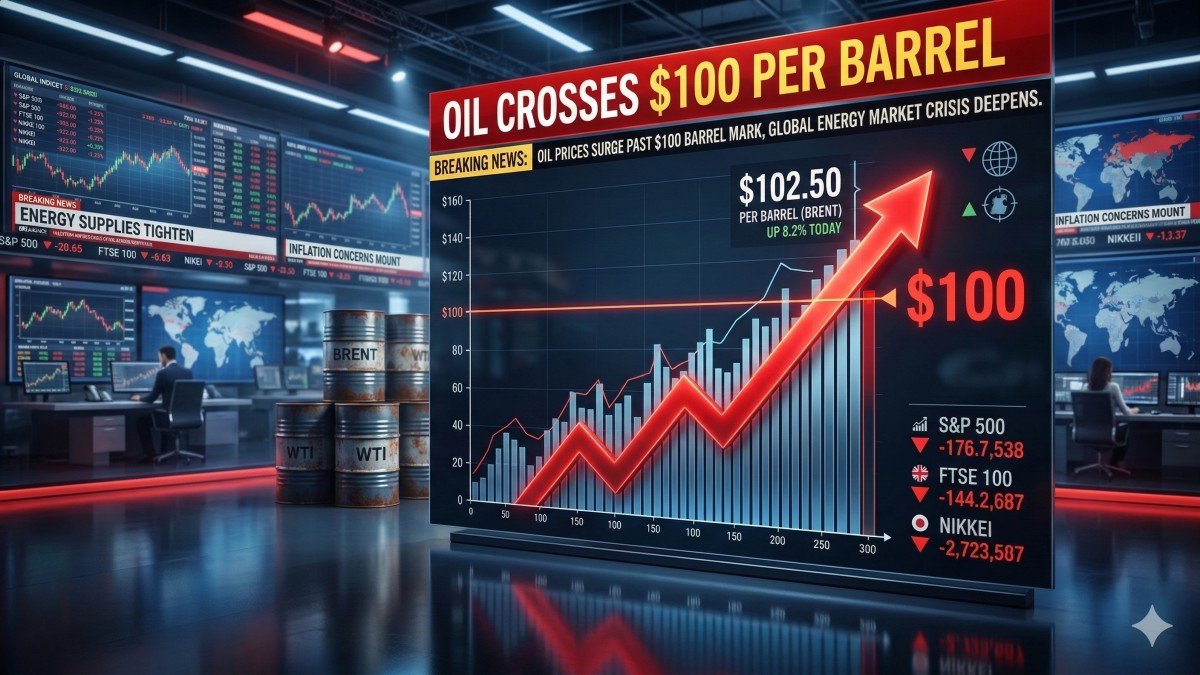
Oil Prices Surge Above $100 Amid Iran War and Strait of Hormuz Crisis
Global oil markets have entered a new phase of uncertainty after crude prices surged past $100 per barrel, triggered by escalating tensions in the Middle East and the continued closure of the critical Strait of Hormuz. The conflict involving Iran, the United States, and Israel has disrupted oil shipments, reduced production in several Gulf countries, and created fears of a global energy crisis.
When trading opened on Sunday evening, both major oil benchmarks jumped dramatically. West Texas Intermediate (WTI) rose more than 20%, reaching $109.75 per barrel, while the global benchmark Brent crude climbed to $109.48. This sudden increase represents one of the most significant price jumps in decades.
The last time oil prices crossed the $100 mark was in 2022 after Russia invaded Ukraine, which triggered global supply concerns. Now, a new geopolitical crisis in the Middle East has once again shaken energy markets worldwide.
📊 Latest Oil Price Update
| Benchmark | Price | Change |
|---|---|---|
| WTI Crude Oil | $109.75 | +20.75% |
| Brent Crude | $109.48 | +18.2% |
| Weekly U.S. Crude Increase | ~35% | Largest jump since 1983 |
Trump Calls Rising Oil Prices a ‘Small Price to Pay’
Shortly after oil prices crossed the $100 mark, U.S. President Donald Trump addressed the situation on his social media platform Truth Social. Trump defended the price spike, calling it a temporary and necessary consequence of eliminating Iran’s nuclear threat.
He wrote that the increase in oil prices was a “very small price to pay” for ensuring global security and preventing Iran from developing nuclear weapons.
The statement quickly drew attention in global markets and political circles. While supporters argued that long-term stability is more important than short-term price increases, critics warned that the surge could worsen inflation and impact consumers worldwide.
Why Oil Prices Suddenly Jumped Above $100
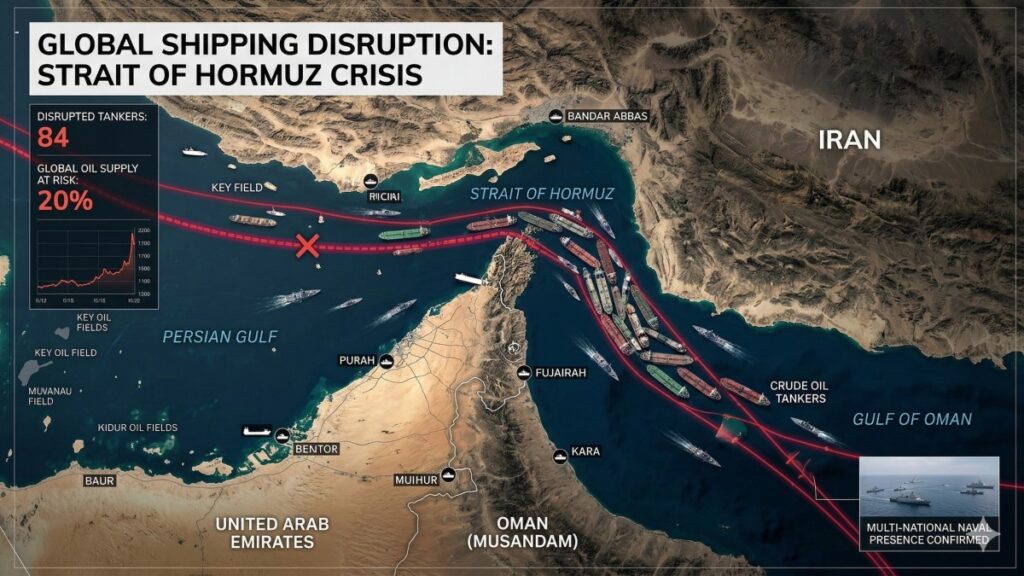
The dramatic rise in oil prices is primarily linked to the closure of the Strait of Hormuz, one of the most important oil transit routes in the world.
Nearly 20% of global oil consumption is transported through this narrow waterway connecting the Persian Gulf to international markets. When Iranian forces declared the strait closed and attacked several oil tankers, shipping traffic through the region almost stopped.
Initially, traders believed the disruption would be temporary. Prices increased from about $70 per barrel before the attacks to around $80 by midweek. However, as the conflict intensified and the strait remained closed, panic spread across energy markets.
By Friday, oil prices had already reached $93 per barrel. When markets reopened after the weekend, prices surged dramatically past $109.
Energy trader Rebecca Babin from CIBC Private Wealth described the sudden change in market sentiment by saying traders had gone from having “ice in their veins to panic in their veins.”
⚠️ Why the Strait of Hormuz Matters
- About 20 million barrels of oil per day pass through the Strait.
- Nearly 20% of global oil consumption depends on this route.
- Major exporters include Saudi Arabia, Iraq, Kuwait, UAE, and Qatar.
- Closure disrupts oil supply to Asia, Europe, and the United States.
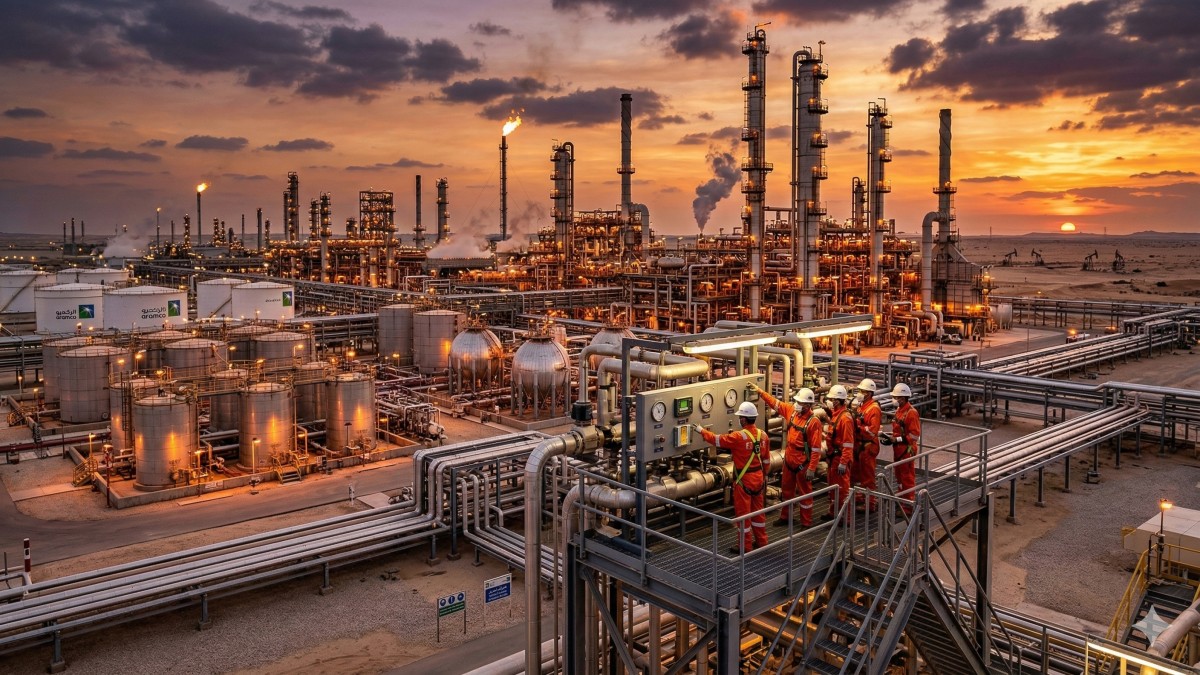
Middle East Producers Cut Oil Output
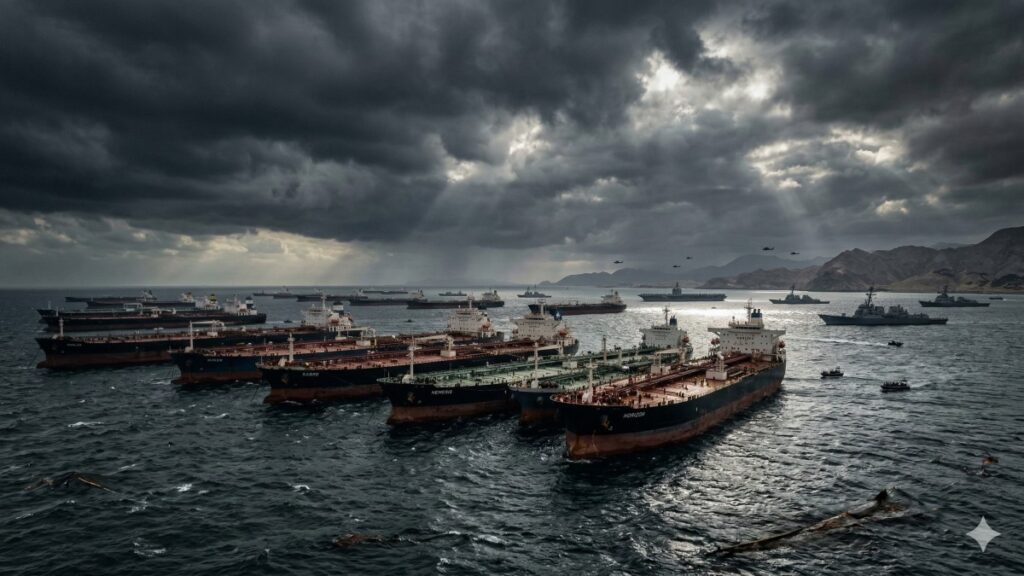
The disruption of tanker traffic has forced several major oil-producing countries in the Gulf to reduce production, mainly because there is nowhere to store the oil being produced.
Tankers are reluctant to pass through the Strait of Hormuz due to the threat of attacks, and insurance costs have skyrocketed.
Kuwait Reduces Production
Kuwait, the fifth-largest producer in OPEC, announced precautionary cuts to both oil production and refinery output. Officials said the move was necessary due to Iranian threats against ships passing through the Strait of Hormuz.
However, the state-owned Kuwait Petroleum Corporation did not disclose the exact size of the production cuts.
Iraq Oil Output Falls Sharply
Iraq, the second-largest producer in OPEC, has experienced one of the most severe disruptions. According to industry officials, production from the country’s three main southern oilfields has collapsed by about 70%.
Before the conflict, these fields produced 4.3 million barrels per day. Production has now dropped to approximately 1.3 million barrels per day.
UAE Carefully Managing Production
The United Arab Emirates, the third-largest OPEC producer, stated that it is carefully managing offshore production to handle storage limitations. While offshore production is being adjusted, the Abu Dhabi National Oil Company confirmed that onshore operations continue normally.
Read Also:
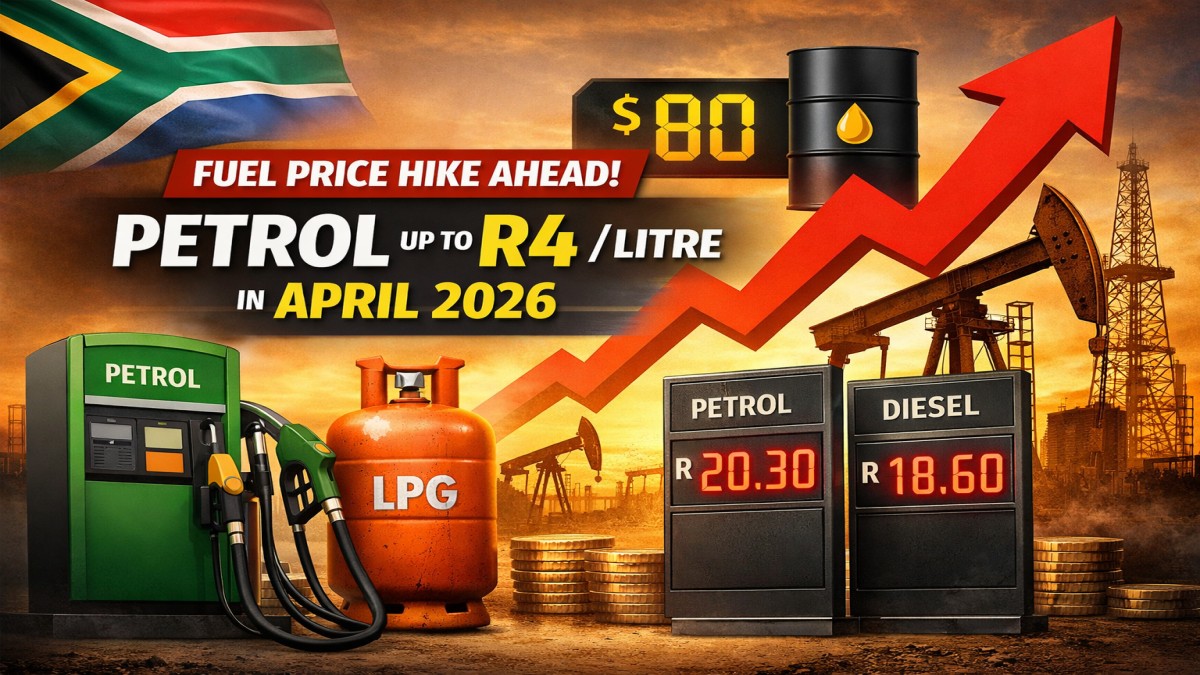
South Africa Fuel Price Warning: Petrol Could Rise Up to R4 in April 2026 Amid Oil Price SurgeGlobal Oil Markets React With Panic
Energy markets around the world are reacting with growing concern about how long the disruption might last.
Insurance companies have raised premiums for ships passing through the Strait of Hormuz, and many shipowners are refusing to send vessels through the region.
The United States has offered to provide naval escorts and insurance support to tankers attempting to pass through the strait. The agency responsible for providing insurance said it could offer up to $20 billion in coverage for vessels.
However, financial institutions estimate that more than $350 billion in insurance coverage would be required to fully protect all tankers operating in the Gulf region.
Some shipowners have expressed hesitation about relying on U.S. military escorts, fearing that the presence of American forces could make ships potential targets.
📉 Global Oil Supply Disruption
- Approximately 20 million barrels per day currently unable to move through the Strait of Hormuz.
- Major Gulf producers are reducing output due to limited storage.
- Oil infrastructure across the Middle East has been targeted in missile attacks.
- Energy markets fear a prolonged supply shortage.
Impact on Fuel Prices Worldwide
The surge in oil prices is already affecting gasoline prices in several countries.
In the United States, the average gasoline price has increased by about 50 cents within a week, rising from $2.98 to $3.45 per gallon, according to AAA data.
Energy analysts warn that the national average price of gasoline could soon reach $4 per gallon if oil prices remain above $100.
Higher oil prices could also lead to:
- Increased transportation costs
- Rising airline ticket prices
- Higher shipping and logistics expenses
- Inflationary pressure on global economies
For countries heavily dependent on imported energy, including many Asian economies, the crisis could significantly affect economic growth.
Can Strategic Oil Reserves Stabilize the Market?
Governments and energy experts are considering using strategic petroleum reserves to stabilize global oil markets.
The United States maintains one of the largest emergency oil reserves in the world. Although it has not yet been tapped during the current crisis, analysts believe it could help ease supply shortages if the situation worsens.
Some oil shipments that normally pass through the Strait of Hormuz could also be redirected through alternative pipelines. However, this solution depends on whether key infrastructure remains intact during the conflict.
According to energy research firm Clearview Energy Partners, strategic reserves and alternative routes could potentially reduce the supply deficit to between 1 and 3 million barrels per day.
When Will Strait of Hormuz Reopen?
U.S. Energy Secretary Chris Wright expressed cautious optimism that shipping traffic through the Strait of Hormuz could resume within a few weeks.
Speaking in a televised interview, Wright said the United States is working to eliminate Iran’s ability to threaten commercial shipping in the region.
However, he also warned that normal shipping operations could take time to restore, especially if infrastructure has been damaged during the conflict.
If oil facilities, refineries, or export terminals across the Gulf region suffer major damage, it could take months for production levels to return to normal.
🕒 Oil Price Timeline During the Crisis
- $70 – Oil prices before the attacks on Iran.
- $80 – Prices rise midweek as tensions escalate.
- $93 – Friday closing price amid growing uncertainty.
- $109+ – Sunday surge after markets reopen.
Global Energy Market Outlook
Before the crisis began, the global oil market was experiencing a surplus supply, which helped keep prices relatively stable.
Now, the closure of a single strategic shipping route has demonstrated how fragile the global energy system can be.
While strategic reserves and alternative transport routes may help stabilize supply in the short term, the situation remains highly uncertain. Much depends on how long the conflict continues and whether key oil infrastructure remains operational.
If the Strait of Hormuz reopens quickly and shipping resumes, oil prices could fall again. However, if the conflict escalates further, the world could face one of the most severe energy crises in recent history.
For now, markets remain on edge as governments, energy companies, and traders closely watch developments in the Middle East.
Disclaimer: This article is based on publicly available reports and market data related to global oil prices and geopolitical developments. Energy markets are highly volatile, and prices may change rapidly. Readers are advised to verify information from official sources before making financial or investment decisions.