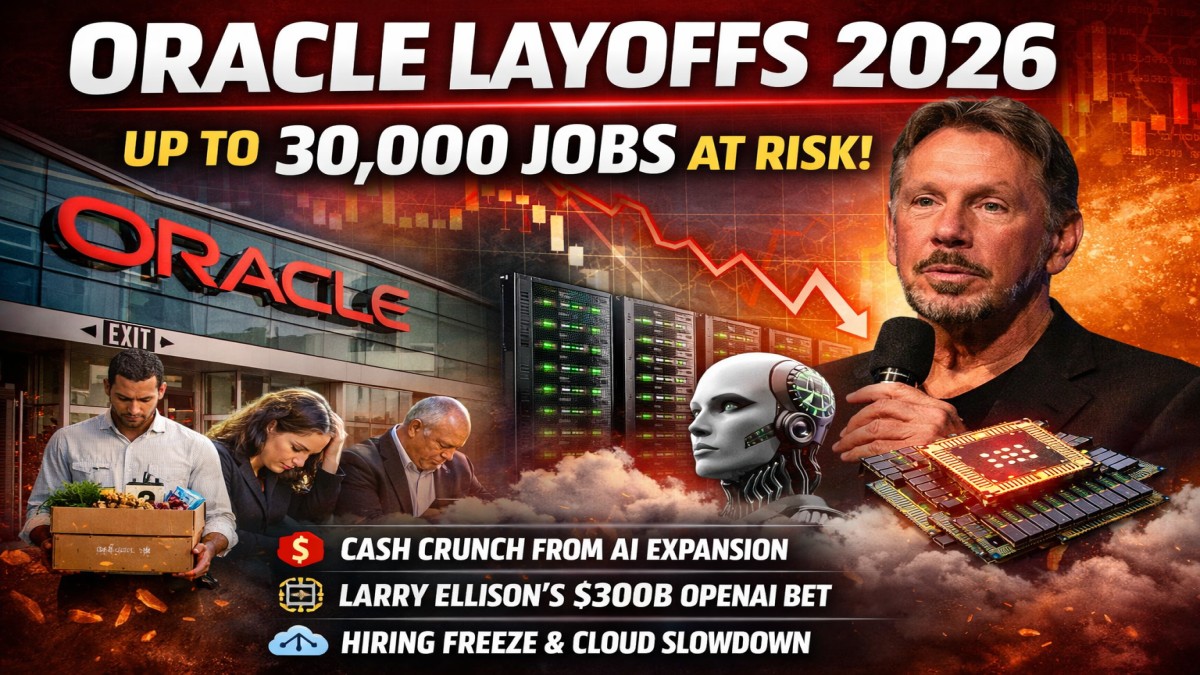
Oracle Layoffs 2026: Tech Giant May Cut Up to 30,000 Jobs Amid Costly AI Expansion
The wave of layoffs sweeping across the global technology industry may soon hit another major company. Reports suggest that Oracle Corporation is preparing for a large round of job cuts that could affect thousands of employees worldwide. According to multiple reports, the layoffs may impact several divisions of the company as it struggles with rising costs linked to massive investments in artificial intelligence and cloud infrastructure.
The potential job cuts come at a time when the tech industry is undergoing a dramatic transformation. Companies are pouring billions of dollars into artificial intelligence, data centers, and advanced computing infrastructure. However, these investments are also putting pressure on financial resources, forcing companies to cut operational costs elsewhere.
Oracle Plans Massive Layoffs as AI Data Center Costs Surge
According to reports citing sources familiar with the matter, Oracle is planning to reduce its workforce across multiple departments. The layoffs could begin as early as this month and may represent one of the largest restructuring efforts in the company’s history.
While the exact number of employees affected has not been officially confirmed, some estimates suggest the total could reach 20,000 to 30,000 employees over the next few months.
The primary reason behind the layoffs appears to be the rapidly increasing costs associated with building and maintaining large-scale AI data centers. As companies race to dominate the artificial intelligence market, the demand for high-performance computing infrastructure has skyrocketed. This has significantly increased capital expenditures for companies operating in the cloud computing and AI space.
Oracle has been aggressively investing in data centers and computing infrastructure to compete with industry leaders like Amazon and Microsoft, both of which dominate the global cloud services market.
🔥 TRENDING K-POP NEWS
BTS Comeback 2026: ‘Arirang’ Album Release, Netflix Special & Global Comeback Concert Announced
BTS is set for a massive comeback in 2026 with the highly anticipated album ‘Arirang’, a Netflix special, and a global comeback live event. Here’s everything fans need to know.
The AI Revolution Is Changing Workforce Needs
Another factor contributing to the potential layoffs is the rapid adoption of artificial intelligence within the company’s operations. According to insiders, some job categories are expected to shrink or disappear entirely as AI-powered systems automate tasks previously handled by human workers.
Many technology companies are now restructuring their workforce to align with the new AI-driven economy. Roles related to automation, machine learning infrastructure, and cloud computing are expanding, while traditional operational roles are shrinking.
Oracle is reportedly targeting certain positions that may become redundant as AI systems improve productivity and efficiency across business operations.
Larry Ellison’s $300 Billion OpenAI Partnership
A major driver behind Oracle’s aggressive AI expansion strategy is its partnership with OpenAI. The deal, estimated to be worth around $300 billion, is expected to transform Oracle into a major infrastructure provider for AI workloads.
The initiative is being strongly pushed by Oracle’s chairman and co-founder Larry Ellison, who has long advocated for turning Oracle into a powerful competitor in the cloud computing and AI infrastructure space.
Under this plan, Oracle is investing heavily in data centers capable of handling large-scale AI processing. Analysts estimate the project could require millions of GPUs and tens of billions of dollars in infrastructure investments.
While the strategy could significantly boost Oracle’s long-term growth, it has also created enormous short-term financial pressure.
Rising Debt and Cash Burn Raise Investor Concerns
The financial impact of Oracle’s expansion strategy has started to worry investors and analysts. Reports indicate that the company has already taken on tens of billions of dollars in new debt to finance its data center projects.
In recent months, Oracle reportedly borrowed more than $58 billion to fund major infrastructure developments in several U.S. states. These projects include large-scale AI data centers designed to support high-performance computing workloads.
The company’s total debt has now reportedly surpassed $100 billion, raising concerns on Wall Street about the sustainability of its aggressive spending.
Oracle has also indicated that it may raise an additional $45 billion to $50 billion through debt and equity financing this year to continue expanding its cloud infrastructure.
Such large capital expenditures are expected to delay positive returns from these investments. Analysts believe the full benefits of Oracle’s AI infrastructure expansion may not materialize until 2030 or later.
Hiring Freeze and Internal Reviews
In addition to layoffs, Oracle has reportedly slowed or frozen hiring across several business units, particularly within its cloud division.
The company recently began reviewing open job listings internally, a move that signals a potential hiring pause as it evaluates workforce requirements during the restructuring process.
Oracle employed approximately 162,000 full-time workers globally as of May 2025, according to filings with the U.S. Securities and Exchange Commission. If layoffs reach the higher estimates being discussed, it could represent one of the largest workforce reductions in the company’s history.
Despite the widespread reports, Oracle has declined to publicly comment on the potential layoffs.
Oracle Isn’t Alone: Tech Industry Facing Massive Layoffs
Oracle’s possible layoffs reflect a broader trend across the technology sector. Over the past year, several major tech companies have announced workforce reductions as they shift resources toward artificial intelligence and automation.
Companies like Amazon and Salesforce have already cut thousands of jobs as part of restructuring plans.
Even companies that are aggressively investing in AI have been forced to reduce workforce sizes in order to balance rising infrastructure costs.
Industry analysts say the shift toward AI is fundamentally reshaping the job market in the tech sector. While some traditional roles are disappearing, demand for specialized skills in machine learning, data engineering, and AI infrastructure continues to grow.
Stock Market Reaction and Financial Pressure
Oracle’s stock performance has also reflected growing investor concerns. While the company experienced strong gains in previous years, the heavy spending on AI infrastructure has started to impact market sentiment.
Reports indicate that Oracle’s shares have fallen significantly from their peak levels in recent months, wiping out hundreds of billions of dollars in market value.
The company also reported substantial cash burn during the first half of its fiscal year, adding to concerns about its long-term financial outlook.
Investors are now closely watching Oracle’s upcoming quarterly earnings report, which could provide more clarity about the company’s financial strategy and restructuring plans.
The Future of Oracle’s AI Strategy
Despite the financial pressure and potential layoffs, Oracle remains committed to its long-term vision of becoming a major player in the AI and cloud computing markets.
The company believes that demand for AI infrastructure will continue to grow rapidly as businesses adopt machine learning, automation, and generative AI technologies.
By investing heavily now, Oracle hopes to position itself as a key provider of the computing power required for the next generation of AI applications.
However, the transition is proving costly and complex. Balancing massive capital investments with financial stability will be one of the company’s biggest challenges in the coming years.
A Turning Point for the Tech Industry
Oracle’s reported layoffs highlight a broader shift occurring across the technology industry. As artificial intelligence becomes the central focus of innovation and investment, companies are reorganizing their operations to adapt to the new landscape.
For many employees, this transformation brings uncertainty. But for technology companies racing to dominate the AI era, the stakes have never been higher.
Whether Oracle’s bold AI bet ultimately pays off remains to be seen. For now, the company is navigating one of the most expensive and transformative periods in its history.